
You spend three hours wrestling with an AI coding agent. You debate architecture, run long debugging session, write a temporary bash script to parse the logs, and finally—it works. The feature is done. You commit the code. You close the chat.
And just like that, the agent forgets everything.
You kept the final product, but you threw away the machine that built it.
Most developers treat AI chat sessions as disposable scratchpads. The back-and-forth iteration is viewed as the messy, temporary scaffolding needed to build a working feature. But if you want to be Agentic Engineer instead of a Vibe Coder, this scaffolding shouldn't be treated as a waste. It's actually totally the opposite - the blueprint for building and constantly improving your agentic harness.
When a master blacksmith creates a legendary sword, they don't smash the mold afterward. They keep it so they can forge the next one effortlessly. The real leap in working with AI coding agents isn't about writing better one-shot prompts. It's about designing systems that learn form your daily chat logs and crystallize that residue into permanent, reusable skills.
Let's look at how to build an agent that actually learns from your interaction with it.
The Core Philosophy: Evolving Harnesses
If you try to force a multi-step, dynamic workflow into a static instruction file (AGENTS.md), you are fighting a losing battle.
Most developers conflate instructions with skills. They dump routing logic, data-parsing rules, and twenty-step standard operating procedures into one massive system prompt. That is an instruction file, and it is a trap. It leads to context pollution, memory degradation, and an agent that forgets step three by the time it reaches step seven.
We are moving firmly into the era of Software 3.0. We aren't just writing code anymore; we are engineering harnesses—living, dynamic environments built on modular capabilities. To do that, you have to separate your rules from your workflows:
- Instruction Files are the employee handbook. They define the persona, the tone, and the absolute boundaries.
- Agentic Skills are the loaded toolbelt. They are discrete, executable packages—a specific prompt, an expected input, and a defined output format—that the agent reaches for only when it needs it.
A static instruction prompt just gives orders. A harness uses skills to execute.
A good harness updates its own toolbelt. Here are the four mental models to make that happen.
1. Updating The Memory

If you are manually editing an agent's custom instructions or system prompt, you are working too hard.
The Concept: The agent must act as its own memory manager. Instead of you constantly correcting its formatting, reminding it to use a specific linter, or adjusting its architectural defaults, the agent dynamically updates its own style and memory documents at runtime.
The Frictionless Cycle: At the end of a highly productive chat session, you don't just close the window. You trigger a wrap-up phase. You tell the agent:
"Review this session. Extract the non-obvious lessons about how I prefer to structure React components, and update your memory file."
It captures the nuance right when the context is richest. Tomorrow, when you open a new session, the agent reads that updated memory file first. It's just-in-time learning, minus the manual data entry.
2. Extracting Feature Blueprint

When a major feature ships, the git and the chat history represent a highly specific, successful path through a dark forest of bugs and bad ideas.
The Concept: The post-mortem. When the PR is merged, the model scans the raw trail of design discussions, failed trials, and code reviews to extract the optimal workflow.
Crystallization: You take the process residue—the temporary plans, the research docs, the sprawling chat sessions, the git commit history—and instruct the agent to condense them into a high-value permanent asset. But instead of just writing passive documentation, you extract a repeatable pattern.
Let’s say you just spent two days grinding out a complex "Image" file entity for your app. You know "Video" and "Audio" entities are coming down the pipeline. Instead of starting from scratch next month, you instruct the agent to mine the session and generate an adding-file-entity skill based on exactly how you built the first one.
You aren't just saving the final code. You are capturing the scaffolding—how the database migrations need to look, which API routes need updating, and what testing edge cases matter. You are automatically promoting a messy, one-off implementation into a permanent factory that can churn out similar features on command.
3. Programmatic Utility Extraction

During a heavy development session, agents often write throwaway helper scripts to parse data, mock a database, or run a specialized test. Don't let those utilities die in the chat history. Instruct the agent to audit its own session, isolate those utility scripts, and write procedural wrappers for them.
You are converting unstructured, ephemeral chat capabilities into structured, declarative skills.
I kept running into this exact friction myself—building complex transient workflows and then losing them to the chat history abyss the moment I closed my terminal. So, I built a tool to automate the harvest.
Stop Guessing, Start Extracting: extract-skill-from-session
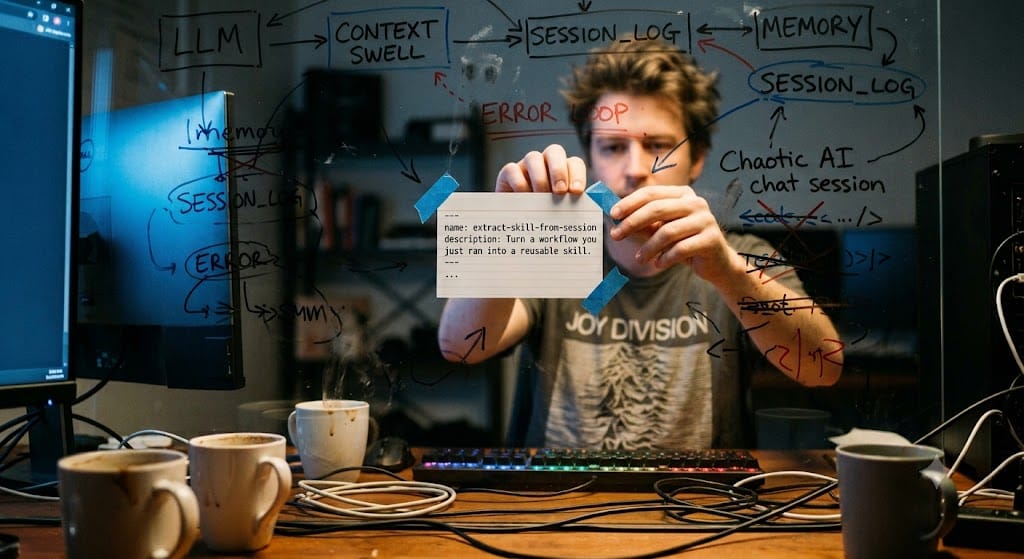
To bridge the gap between a messy chat and a permanent tool, I built extract-skill-from-session, a dedicated utility skill designed to strip the noise and keep the capability.
With this running, the next time your agent needs to validate a payload or mock a database, it won't have to invent a way to do it. It will just reach into its toolkit and pull out the exact utility it forged yesterday.
4. Dynamic Output-Style Evolution

If you find yourself repeatedly telling your agent to "stop being so verbose" or "explain this more intuitively," your developer harness is leaking.
The Concept: Cosmetic isolation. You define a dedicated output-style file that controls exactly how your AI coding agent formats its responses—governing its verbosity, visual structure, headings, code-block layouts, and depth of explanations.
The Standing Rules: The power lies in keeping presentation entirely separate from behavioral instruction. You give the agent two strict guidelines:
- Cosmetic only: This file shapes formatting aesthetics only, never core coding behavior.
- Self-updating memory: The agent treats this file as active memory. Whenever you correct its tone, request a cleaner breakdown, or adjust its formatting mid-chat, the agent dynamically updates the style file on its own.
- The Payoff: One-off corrections immediately solidify into permanent presentation preferences, causing the agent's outputs to rapidly converge on exactly how you like to read them. For ultimate portability, you can bundle this evolving style file into a
set-output-styleskill to instantly initialize your personalized style on any new machine you use.
5. The Evolving Harness Bundle (My Personal Skills)
If you want to jumpstart this process, you don't have to build all these extraction tools from scratch. The capabilities we just discussed—extracting workflows, defining output styles, and managing agent memory—have been crystallized into a ready-to-use toolkit.
You can find my personal skills bundle here: The Evolving Harness Skills Repository.
This bundle contains a suite of modular agent skills specifically designed to help your AI coding assistant learn and adapt. It includes tools like:
extract-skill-from-session: Automatically condenses complex chat workflows into reusable, permanent skills.save-learned-lessons: Captures user chat session lessions and learns form corrections, routing lessons to the appropriate skill, documents and memory.using-evolving-harness: A master routing skill that orchestrates tasks through correct lifecycle phases and automatically runs the evolution loop at the end of a session.set-output-style: Dynamically manages and applies your preferred output formatting and verbosity.
How to use it:
You can install this bundle directly into Claude Code using the official plugin marketplace. In your Claude Code CLI, simply run:
/plugin marketplace add Harduex/skills
/plugin install harness-evolution@harduex
/reload-plugins
Alternatively, if you are using the Agent Skills package manager, you can install the catalog directly into your project by running:
npx skills add Harduex/skills
Once installed, your agent can invoke them dynamically. When you finish a tough debugging session, you just say, "Run extract-skill-from-session," and the agent will handle the rest—turning your disposable chat into a permanent asset.
Final Thoughts
We are moving past the era of the disposable chat.
When you start treating your daily interactions not as one-off conversations, but as the foundational training data for your own personalized AI harness, the compounding returns are staggering. You stop solving the same problems twice. Your agent stops making the same formatting errors. You stop starting from zero.
We are no longer just writing code.
We are building the minds that write it.