

"It's not events that upset us, but our opinions about them." — Epictetus
If you think Stoicism is about suppressing your emotions and being a feelingless robot, you're dead wrong. This is arguably the most practical philosophy ever created. A philosophy born not in quiet academic halls, but out of chaos, shipwrecks, and political tyranny.
Here is everything you need to know about Stoicism to get started, filtered through the lens of modern life. No academic fluff. Just what works.
It All Starts With a Shipwreck

Picture this: you lose your entire business, all your wealth, and find yourself penniless in a foreign city. That's exactly what happened to Zeno — a Phoenician merchant whose ship sank. Instead of giving in to despair, he discovered philosophy in Athens and started teaching on a painted public porch (in Greek, Stoa — hence "Stoicism").
The key lesson? You can't control the shipwreck. You only control what you do after it.
The early Stoics had a brilliant metaphor: You are like a dog tied to a moving cart. The cart (life) is going wherever it wants. Your choice is simple — you can trot cheerfully alongside it, or you can lie down and get dragged. But the cart is moving either way.
The Four Pillars (The Cardinal Virtues)
The Stoics believed that a good life rests on four virtues. They are independent but work in sync.
- Courage: This isn't just charging into battle. It's the moral courage to be yourself. To think for yourself, to speak the truth when it's uncomfortable, and to put your comfort on the line. The alternative to courage isn't just cowardice — it's apathy and not really living at all.
- Discipline / Temperance: This is your ability to control yourself. Knowing when to hit the gas (get off the couch) and when to hit the brakes (don't burn out from overworking). In a world of constant noise and cheap dopamine, having boundaries is a superpower.
- Justice: Forget the legal system. We're talking about ethics here. The Stoics believed we were made for each other. Justice is the ability to step into someone else's shoes, to not rush to judge, and to understand that we are all part of something bigger.
- Wisdom: The ultimate filter. Wisdom is what helps you know what is worth being courageous about and when you need to be disciplined. It's not given for free — it's earned through experience, reading (conversations with the dead), and realizing what actually matters.
The Roman Giants: The Big Three
While the Greeks were the theorists, the Romans battle-tested Stoicism in real life. And by "real life," we mean running empires, enduring slavery, and surviving under crazy tyrants.
- Seneca (The Senator): The second richest man in Rome, advisor to the unstable Emperor Nero. Seneca is the man of compromises — trying to manage the chaos from the inside. Despite his contradictory life, he left behind the most beautiful and brutally honest essays on managing time, anger, and anxiety.
- Epictetus (The Slave): Born into slavery, physically abused, but absolutely free in his mind. He is the original source of the idea that true freedom isn't a social status, but a state of mind. His message is simple: There are things up to you, and things not up to you.
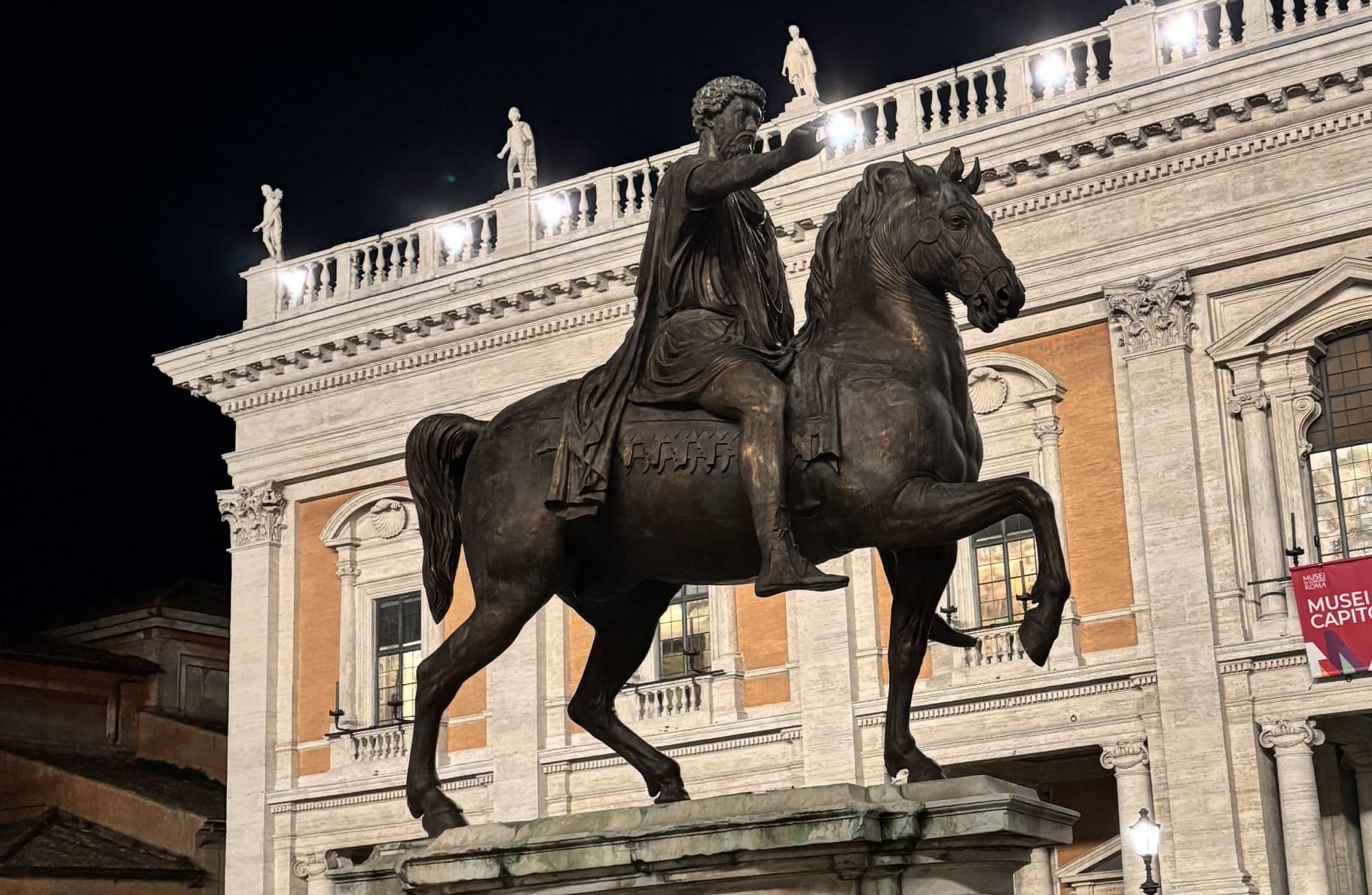
- Marcus Aurelius (The Emperor): The most powerful man in the world, who could literally do whatever the hell he wanted. Instead, he sat in his tent at night during a war and wrote a personal journal ("Meditations") just to remind himself not to be a jerk. It's the playbook of a man trying to keep his sanity under the crushing weight of responsibility.
Your Stoic Toolkit (The Practices)

How do you apply all this today? Here are a few tools — tested by centuries — that beat any modern "life hack" trend.
Perspective Shifts (How to see the world differently)
- The View from Above (Plato's View): Imagine events as if seen from high overhead, taking a bird's-eye view of everything all at once. By zooming out across history, time, and space, you can see how insignificant our daily squabbles and perceived emergencies actually are. This practice reminds us of our brief place in the vast cosmos and induces a profound sense of calm.
- Memento Mori (Remember You Must Die): You are not immortal. Seneca says we aren't moving toward death — we are dying every day. The time that has passed already belongs to death. Use this fact not to despair, but to filter out the meaningless noise from your life.
- Amor Fati (Love Your Fate): Don't just accept what happens to you — love it. Every hardship is an opportunity to practice virtue. Project failed? An opportunity to learn a new lesson. Met a difficult person? An opportunity to train your patience.
- Hierocles' Concentric Circles (Cosmopolitanism): Visualize your social world as a series of concentric circles, starting with yourself and expanding outward to family, neighbors, fellow citizens, and all of humanity. The Stoic task is to actively pull these outer rings inward. Treat strangers like neighbors and neighbors like family, cultivating a profound sense of justice and duty to the common good.
Daily Habits (How to train your mind in peacetime)
- Morning and Evening Meditations: Bookend your days with structured reflection. In the morning, prepare for the day by anticipating the difficult tasks and obnoxious people you might encounter so you aren't caught off guard. In the evening, review your day unflinchingly: ask yourself what bad habits you curbed, what mistakes you made, and how you can improve tomorrow.
- Voluntary Hardship: Intentionally subject yourself to temporary discomfort during times of peace and prosperity. Eat meager food, wear shabby clothes, or take cold baths to act as a training ground for resilience. By experiencing hardship on your own terms, you prove to yourself that your deepest fears are easily survivable.
- Contemplating the Sage (Modeling Virtue): When facing a difficult situation, ask yourself what a wise mentor like Seneca or Marcus Aurelius would do. Imagine that this benevolent mentor is constantly observing your actions and thoughts. Knowing you have a "witness" standing by creates self-awareness and helps you align your behavior with your highest values.
In-the-Moment Tactics (How to handle a crisis)
- The Dichotomy of Control: Divide your life into two columns: "What I can control" and "What I cannot control." Learn to become brutally indifferent to the second column. Only worry about the first.
- Negative Visualization (Premeditatio Malorum): An invention of Seneca. Instead of picturing everything going perfectly, visualize the worst-case scenario. It's not depressing at all — it's actually liberating. You realize that even if things go totally sideways, you'll be fine.
- Objective Representation (Phantasia Kataleptike): Strip away emotional rhetoric and value judgments, and describe events purely factually. Remind yourself that fine wine is merely fermented grape juice, roasted meat is a dead bird, and a purple robe is just sheep's wool dyed in shellfish blood. By stripping things down to their bare elements, you remove their power to overwhelm you.
- Cognitive Distancing: Remember that it is not events that upset us, but our judgments and opinions about those events. When you feel a strong negative emotion, take a step back and remind yourself that it is just a feeling, automatic thought or an "impression". Speak to the thought directly, stripping away its power to shape your reality.
- Depreciation by Analysis (Divide and Conquer): If a situation or a craving feels unbearable, break it down into its smallest components. Isolate the present moment from the past and the future, and ask yourself what specifically in this exact moment is so unbearable. By tackling hardships one tiny piece at a time, you prevent your mind from catastrophizing.
- The Reserve Clause (Hupexhairesis): Undertake every action with a backup option or caveat, such as "Fate permitting" or "God willing". Your job is to try your best and aim the bow, but external results are ultimately out of your hands. By attaching a reverse clause to your goals, you can pursue them vigorously while remaining peacefully detached from the outcome.
The 80/20 Rule of Stoicism (Final Thoughts)
If you only remember one thing from this guide, let it be this:
You don't control what happens to you. You only control how you respond to it.
The harder and messier the situation, the greater the opportunity to show character. Stoicism isn't a book you read once and put on a shelf. It's a daily practice. Every day you wake up and start over.
As Marcus Aurelius told himself:
Fight to be the person philosophy tried to make you.